


The Secret World of Micro Bubbles: Facts That Will Amaze You
Micro bubbles might sound ordinary, but these microscopic powerhouses possess extraordinary capabilities in medical science.
These tiny bubbles are smaller than red blood cells, measuring less than 10 μm in diameter—about 1/100th of a human hair. Their minuscule size hasn’t stopped them from becoming instrumental in revolutionizing medical imaging and treatment.
The science behind microbubbles reveals tiny spheres with a gas core wrapped in a protective shell made of proteins, lipids, or polymers. These remarkable structures work as “theranostic” agents that provide contrast for diagnostic imaging and serve as targeted drug delivery vehicles. Europe’s most popular ultrasound contrast agent, SonoVue, contains microbubbles filled with sulfur hexafluoride—a non-toxic gas that patients fully exhale through their lungs within minutes. Scientists can break these bubbles open by increasing ultrasound power, which releases drugs exactly where needed. This precision makes microbubbles an invaluable tool in modern medicine.
What Makes a Microbubble Unique?

Image Source: ResearchGate
Micro bubbles are different from their larger cousins. They have special properties that make them powerful tools in medicine and environmental applications. Their size, shell composition, and gas core give them these remarkable characteristics.
Size comparison: microbubble vs regular air bubble
These tiny bubbles measure just 1 to 10 μm in diameter—about the same size as red blood cells. Regular air bubbles or macrobubbles are thousands of times bigger. The size difference creates amazing effects. A milliliter of 100 nm diameter bubbles has 1000 times more surface area (240 m²) than the same volume of 0.1 mm bubbles (0.24 m²). Regular bubbles quickly float up and pop at the water’s surface. These microbubbles act differently—they float up slowly and go through “shrinking collapse” instead of bursting.
Shell materials: lipids, proteins, polymers
Microbubbles have three main types of protective shells:
- Lipid shells (3-5 nm thick) are a great match for elasticity and acoustic response
- Protein shells (15-150 nm thick), often made with bovine serum albumin (BSA), give strong stability
- Polymer shells (50-500 nm thick) last longer and can carry more drugs
The shell type shapes how each microbubble behaves. Bubbles with longer lipid chains become less round, while shorter chains create more perfect spheres. Saturated lipids also stay stable longer than unsaturated ones.
Gas core and stability in the bloodstream
The gas inside these bubbles is vital for how they work and last. The first microbubbles used air, which dissolved fast in blood. Today’s versions use gasses that don’t dissolve easily, like perfluorocarbons or sulfur hexafluoride. These gasses help bubbles last much longer in the body.
The Young-Laplace equation explains how these bubbles stay stable. Stability happens when pressures on both sides of the interface balance out. The gas core pushes outward while the liquid and shell push inward. The bubble keeps its shape when these forces balance.
Shell thickness affects which ultrasound frequencies work best—thicker shells need higher frequencies to create cavitation. Doctors use this feature to control medical treatments precisely. These bubbles are now powerful tools for both imaging and therapy.
How Microbubbles Interact with Ultrasound
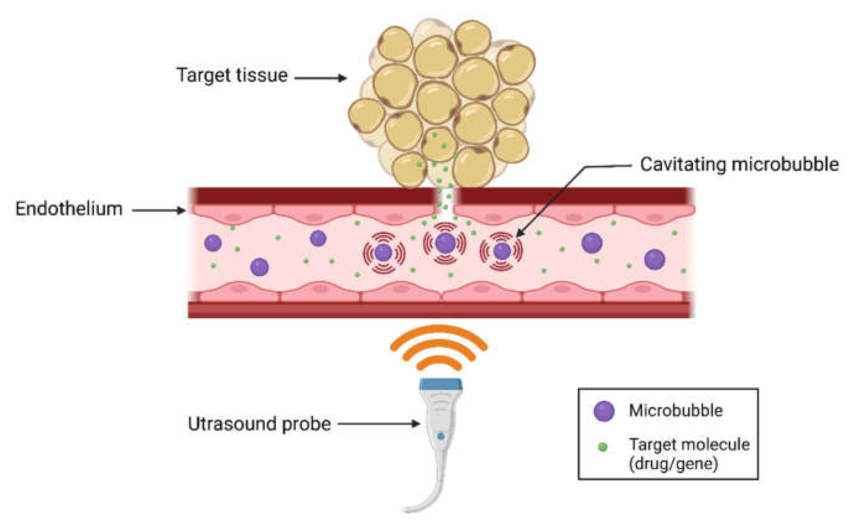
Image Source: ResearchGate
The interaction between micro bubbles and ultrasound waves creates an amazing acoustic phenomenon that revolutionizes medical imaging. Something remarkable happens at the microscopic level as ultrasound pulses meet microbubbles.
Oscillation and echo generation
Microbubbles react to ultrasound waves by expanding and contracting in sync with sound wave pressure changes. This resonance behavior works best at diagnostic ultrasound frequencies, which makes microbubbles reflect thousands of times more than normal body tissues. The microbubbles go through volume oscillations that switch between compression and rarefaction phases.
The acoustic response changes based on the applied pressure. Microbubbles move symmetrically in a linear way at low mechanical index (MI < 0.1). They become more resistant to compression than expansion as the MI rises to 0.1-0.3, which creates stable or non-inertial cavitation. The microbubbles end up breaking down at higher pressures (MI > 0.3-0.6) due to forced expansion and compression.
Why microbubbles are ideal for imaging
Microbubbles make excellent contrast agents because their gas core compresses much more than red blood cells. This creates a big difference in acoustic impedance between the microbubbles and surrounding blood or tissue. Their backscatter signal can be much stronger than blood and most tissues.
A microbubble’s echogenicity grows with its size – the ultrasound scattering cross-section directly relates to the sixth power of its radius. The size must stay under 6-8 μm for intravascular applications to safely move through capillary beds.
Nonlinear scattering and signal clarity
The most valuable feature of microbubbles is their nonlinear acoustic behavior. Microbubbles create backscatter signals at different frequencies—harmonics, sub-harmonics, and ultra-harmonics during stable cavitation. Harmonic imaging techniques use this property to improve the bubble-to-tissue contrast ratio.
Detection methods have evolved beyond basic harmonic imaging. Phase inversion uses an ultrasound pulse and its phase-inverted copy—the received signals cancel linear tissue reflections while keeping nonlinear bubble signals. Amplitude modulation uses different intensity pulses to isolate nonlinear echoes. These methods give amazing sensitivity and resolution for molecular imaging applications.
Microbubbles of 1-2 μm can still participate in nonlinear scattering at high ultrasound frequencies (20-30 MHz). This opens new possibilities in ophthalmology, dermatology, and small animal imaging.
Microbubble Applications in Medicine
Micro bubbles have transformed medical applications beyond imaging. These tiny microscopic spheres work as powerful tools in many therapeutic areas.
Ultrasound contrast agents
Doctors have used microbubbles as ultrasound contrast agents for almost 20 years. FDA-approved agents like Lumason (SonoVue in Europe), Definity, and Optison are now standard tools. Their strictly intravascular nature makes them excellent blood-pool tracers. Doctors use them in everything from echocardiography to hepatology. CEUS (contrast-enhanced ultrasound) matches CT and MRI performance when checking hepatic lesions.
Targeted drug delivery
Microbubbles show great promise in carrying therapeutic agents. Here’s what they can do:
- They transport drugs, genes, or cells to treat brain, heart, and cancer conditions
- When activated by ultrasound, microbubbles create temporary gaps in biological barriers, including the blood-brain barrier
- These gaps can last anywhere from seconds to hours, giving doctors a vital “window of opportunity”
No other method can open the BBB to deliver drugs to the brain without surgery.
Molecular imaging and receptor targeting
Scientists can now design microbubbles with targeting ligands—antibodies, peptides, and glycoproteins—that stick to specific disease biomarkers. Each square micron can hold several hundred to several thousand of these ligands. These targeted microbubbles help detect unstable atherosclerotic plaques, track inflammation, and show tumor blood vessels clearly.
Theranostics: combining therapy and diagnostics
The most exciting breakthrough comes from theranostic microbubbles that can diagnose and treat at the same time. These smart agents let doctors watch drug delivery as it happens. Clinical trials are testing them to boost radiation therapy results in liver cancer. Studies show they can make radiotherapy work better by damaging tumor blood vessels both physically and chemically.
Why Thera-Clean’s Microbubble Science Stands Out
Thera-Clean’s innovative approach uses micro bubbles to create a cleaning breakthrough that goes beyond traditional methods. Their technology stands out with several unique advantages that make life better for animals and their caretakers.
Deep-pore penetration explained
Thera-Clean’s micro bubbles work better than other cleaning methods. These microscopic bubbles penetrate deep into pores and follicles and lift out trapped dirt, debris, and microorganisms. The bubbles carry a negative electrical charge that attracts positively charged particles like dirt and dead skin cells. This pulls debris away from the skin surface without any harsh scrubbing.
Comparison to traditional chemical baths
Traditional baths depend on chemicals to dissolve oils, while:
- Thera-Clean needs only water and microbubbles
- Regular cleaning methods often leave behind residues that irritate sensitive skin
- Chemical shampoos can disrupt natural skin flora and pH balance
- Microbubble technology cleans deeply without removing essential oils
Research-backed results and veterinary studies
Veterinarians have seen this technology’s effectiveness in treating various skin conditions firsthand. Animals with dermatitis, hot spots, and yeast infections show promising improvements with this gentle yet thorough cleaning process. Many practitioners who doubted the method now recommend these treatments after seeing consistent positive results.
Frequently Asked Questions (FAQ)
People often ask about treatment frequency, safety for different animals, and which conditions respond best to microbubble therapy. Thera-Clean answers these questions based on real results from thousands of animal treatments.
Q1. How small are microbubbles compared to everyday objects? Microbubbles are incredibly tiny, measuring less than 10 micrometers in diameter. To put this into perspective, they are about 1/100th the width of a human hair and even smaller than red blood cells.
Q2. What makes microbubbles useful in medical imaging? Microbubbles are ideal for medical imaging because they are highly reflective to ultrasound waves. Their gas core creates a significant acoustic impedance mismatch with surrounding tissues, resulting in a much stronger echo signal than blood or most body tissues.
Q3. Can microbubbles be used for drug delivery? Yes, microbubbles can be used for targeted drug delivery. They can carry drugs, genes, or cells to specific areas of the body. When activated by ultrasound, they can create temporary openings in biological barriers, such as the blood-brain barrier, allowing for localized drug delivery.
Q4. Are there any side effects associated with using microbubbles in medical procedures? While the full safety profile of microbubbles is still being studied, the incidence of side effects is generally low. Minor adverse events such as dizziness, itching, or nausea may occur in rare cases, but serious complications are extremely uncommon.
Q5. How do Thera-Clean’s microbubbles differ from traditional cleaning methods? Thera-Clean’s microbubble technology uses only water and microbubbles for cleaning, unlike traditional chemical baths. The negatively charged microbubbles can penetrate deep into pores, attracting and lifting out dirt and debris without harsh scrubbing or leaving chemical residues that might irritate sensitive skin.
Conclusion
Microbubbles represent science’s most captivating phenomena. These tiny spheres are invisible to our eyes yet powerful enough to revolutionize medicine and animal care. Each bubble, measuring just 1/100th of a human hair, serves as a versatile tool in multiple fields. Their shell composition, gas cores, and interaction with ultrasound waves make them invaluable for diagnostic imaging, drug delivery, and therapeutic applications.
Scientists continue to invest resources in microbubble research because of their remarkable medical applications. These microscopic powerhouses serve as contrast agents, targeted drug delivery systems, and molecular imaging tools. They can even open the blood-brain barrier, which was previously impenetrable. On top of that, their theranostic capabilities combine diagnosis and treatment in single applications, which shows this technology’s versatility.
Thera-Clean has expanded this science beyond medicine by developing a cleaning technology based on electrical attraction instead of harsh chemicals. Their system uses microbubbles’ negative charge to lift dirt and debris from deep within pores. This happens without disturbing the skin’s natural oils or pH balance, which gives animals a gentler yet more effective clean than traditional chemical baths.
The benefits of microbubble technology are simple – deeper cleaning, less irritation, and better results for animals with skin conditions. Studies continue to confirm these outcomes in pets of all sizes. You can reach out to us about Thera-Clean to learn how this technology can help your pets or practice.
These tiny bubbles show how microscopic innovations can solve ground problems. From better medical imaging to life-saving drug delivery and gentle cleaning solutions, microbubbles prove that the smallest things often create the biggest impact.